


[weglot_switcher]

Interesting Articles

Why does your hair leave you? 8 causes of hair fall and breakage

Why does your hair leave you? 8 causes of hair fall and breakage

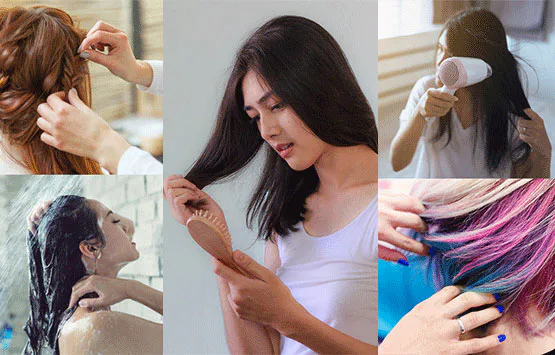
Have you ever wondered why your hair keeps falling out even though you take really good care of it? Hair fall can have many causes, and some of them are everyday habits you might be overlooking. Today the admin has listed 8 causes that keep making hair fall again and again until it becomes noticeably thin. 1. Pulling your own hair — Do any of you pull your own hair? Some people do it absentmindedly while lost in thought — the more they daydream, the more they pull. Some like having friends pull at itchy strands. Some even pull their hair when stressed or upset. Pulling frequently — watch out, ladies, you might go bald without realizing it. Repeatedly pulling hair causes patchy thinning that can eventually lead to baldness, and it weakens the hair roots so that new growth is not strong and falls out easily. 2. Shampooing habits — We understand that the weather here is incredibly hot — sweating almost constantly, so hair gets smelly easily from the heat, pollution, and various odors. That's why many people wash their hair every day. But did you know that washing hair too frequently is a big no-no? Over-washing dries out the scalp, causing irritation and itching that eventually leads to dandruff — and once you have dandruff, hair fall follows. Washing every other day is enough. In between, you can turn to dry shampoo. 3. Styling and hair treatments — Let's be honest, looking good is very important to us, especially styling our hair beautifully when going out. Dyeing, using spray, straightening, and all sorts of other treatments are also causes of hair fall, because we expose our hair and scalp to too many chemicals and heat — damaging them in the process. Various styles, whether braids or tight buns, can also cause hair breakage and fall, because rubber bands and hair clips that are too tight weaken hair right from the roots. 4. Diet — Who says "once you're grown up, you can eat anything"? That's not wrong per se, but it's really not advisable. We need to watch what we eat, because what we drink and eat affects the health of our hair and scalp too. People who love spicy food especially need to be careful — spicy food stimulates high blood pressure and constricts blood vessels, reducing blood circulation to the hair roots. Weak hair roots then break and fall out easily. 5. Protein deficiency — Following on from the previous point, many people wonder what they need to eat to have healthy hair like others. It's not that complicated — the best foods for nourishing hair are protein-rich foods. If your body is deficient in protein, hair becomes fragile and falls out easily — and you might even find gray hairs showing up too. 6. Hereditary hair fall — Some people have never dyed their hair, never used chemicals, take excellent care of their hair, yet it still keeps falling. That's when you need to look back at older relatives — parents, grandparents — to see whether anyone had thinning or falling hair. Hereditary hair fall is mainly caused by the male hormone DHT, which is passed down from generation to generation. DHT reacts with the hair follicles, causing them to atrophy, contract, and shrink until hair gradually falls out. Hair strands become thin, weak, and easy to fall out — and in severe cases, baldness can result. 7. Using harsh shampoos — One thing that directly impacts our hair is the hair care products we use regularly — especially shampoos and conditioners. These can also cause hair fall. Every brand has a different formula with different ingredients, and not all formulas suit every hair type. Formulas with harsh chemicals can damage hair even more. If you don't choose carefully, it can lead to heavy hair fall. So it's recommended to choose a gentle, chemical-free shampoo to minimize chemical exposure for your scalp and hair. 8. Emotional stress and pressure — Stress is a problem that can affect people of all genders and ages, because it arises so easily from both small and large issues. Did you know that aside from causing headaches and a bad mood, stress also causes hair fall? Prolonged accumulated stress slows the hair follicles' ability to produce new hair strands, and hair falls out more and more. This is really not good, ladies — we must find ways to relieve stress for the sake of our hair! Anyone who fits several of these 8 points — if it's happening regularly, fix your habits quickly before your hair leaves you. Most importantly, don't forget to use AloEx products to nourish your hair roots for strength, reduce hair fall, and help new hair grow back. ^^ Order AloEx at LINE: @AloEx or click http://bit.ly/LINEAloExFB — free shipping nationwide.

Read more »
The 4 cleansing-agent families in shampoo you've never heard of

The 4 cleansing-agent families in shampoo you've never heard of

Today's hair cleansing products and shampoos contain many different ingredients, such as preservatives, foaming agents, and conditioning agents, etc. However, the most essential ingredient that cannot be omitted is the cleansing agent, or surfactant. The molecular structure of this agent can attract oil-based dirt and help rinse it away with water. The cleansing agents used in shampoos are classified into 4 groups based on their ionic charge when dissolved in water, as follows: Anionic surfactants have high cleansing efficiency, produce a lot of foam, and are low in cost — but they may strip too much oil from hair and scalp, leaving hair in poor condition after washing, and may cause irritation for those who are sensitive to shampoo. Most regular shampoos use this group as the primary cleansing agent, mixed with nonionic surfactants to reduce irritation. Examples of anionic surfactants: Sodium lauryl sulfate, Sodium lauryl ether sulfate, Ammonium lauryl sulfate, etc. Cationic surfactants produce less foam and have less cleansing power than anionic agents, but they are excellent at restoring the condition of hair and skin. They are therefore often used in conditioning products (hair conditioners). Examples of cationic surfactants: Cetrimonium chloride, Behentrimonium chloride. Amphoteric surfactants carry both positive and negative charges. They cleanse hair well, produce plenty of foam, and at the same time help preserve hair condition after washing without irritating the scalp, because they have low alkalinity. However, because they are expensive, they are not widely used. Due to their low irritation potential, they are often the main ingredient in shampoos for children and for those who are sensitive to regular shampoos. Example of amphoteric surfactants: Amino propionates. Nonionic surfactants have high cleansing ability and maintain good hair condition after washing, but produce little foam and are expensive. They are typically used as supplementary cleansing agents in regular shampoos to help reduce irritation caused by the anionic agents used as the primary ingredient. Example of nonionic surfactants: Cocomide monoethanolamine. Now that you are familiar with all four groups of surfactants, let's look at which type of shampoo or hair care product suits which type of user: Normal hair — If possible, shampoo with a product that uses nonionic surfactants as the primary ingredient, or a sulfate-free shampoo. If not available, use a regular shampoo followed by a conditioning product every time. Oily hair — Shampoo regularly with a regular anionic-formula shampoo and rinse thoroughly with cool water. Dry hair — Avoid washing hair every day. When shampooing, use an amphoteric-formula shampoo, and nourish hair with a conditioning product that contains cationic surfactants — especially a deep conditioner. Sensitive scalp — Use an amphoteric-formula shampoo or a baby shampoo. AloEx encourages all readers to choose a shampoo that suits your individual hair and scalp condition, so you can keep your hair clean and healthy. Many thanks for the helpful information from the Department of Pharmaceutical Sciences and Pharmaceutical Industry, Faculty of Pharmacy, Chulalongkorn University, "Cosmetics in Everyday Life," Bangkok: Chulalongkorn University, 2001, pp. 154–160.

Read more »
What did the ancient Thais use to 'wash' their hair?

Back then, what did you use to “wash your hair” with?

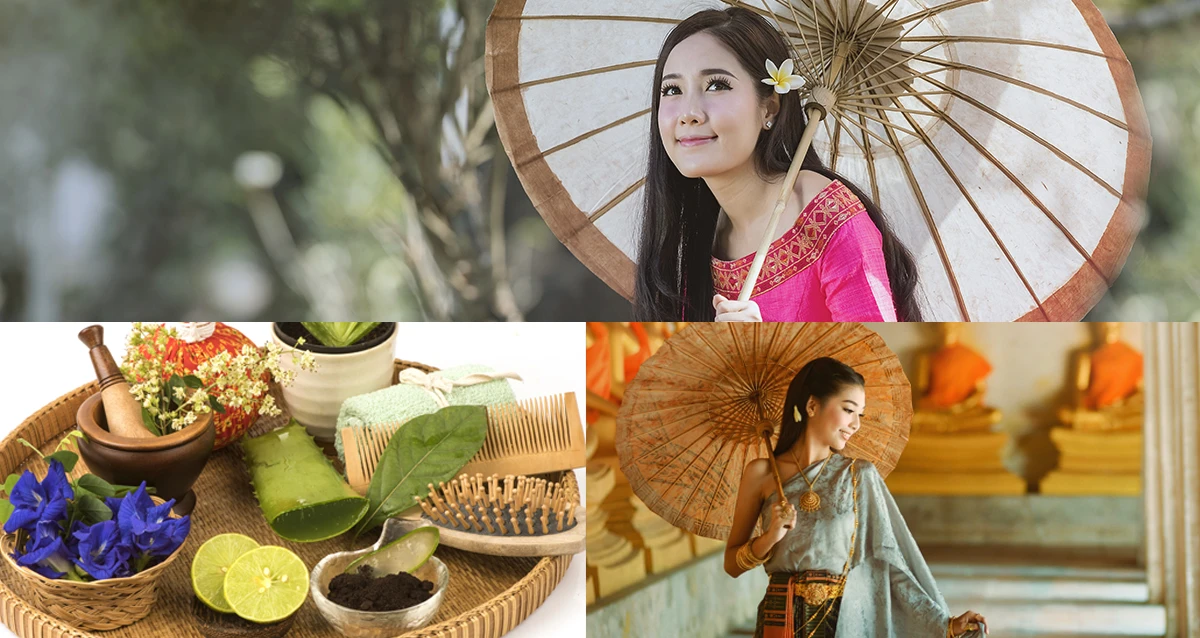
Today AloEx would like to introduce you to the herbs that the character Mae Ying Kara-Kay used to wash her hair. Each herb has different properties. Some you may have heard of before, but every one of them has properties that help nourish hair and scalp. Let's take a look, dear friends! 1. Bai Mi (Indian Tulip / Thespesia populnea) — also known as Mi Mhen — an herb found in the Lanna region, abundant in Nan province. People in the old days would boil Bai Mi leaves in water, or crush them and mix with water to get a pleasant fragrance, then use the water to wash hair. Some households would soak Bai Mi leaves as a hair mask — by pounding the leaves finely, mixing with rice-washing water, and soaking the hair — to get soft, beautiful hair, free of dandruff, reducing scalp itching, reducing hair fall, and helping to strengthen the scalp. 2. Henna — People in the old days liked to pound Henna finely, strain through cheesecloth, and use the resulting liquid to dye hair a naturally thick, dark color — while also strengthening the scalp. This herb is not only used by Thai people — it is also popular in many other countries, such as India, and is widely made into hair dye products. 3. Soapnut — A natural herb that can produce foam on its own. People in the old days would crush the soapnut to remove the inner seed, then rub it with water to use for washing clothes or washing hair. Alternatively, they would crush it until it cracked and boil it in about 1 cup of water, then use it to soak hair or wash hair. Its properties are also very good — it helps reduce hair fall and treats scalp conditions. 4. Kaffir Lime — Ladies in the old days would char Kaffir Lime over a flame, cut it in half, and rub the Kaffir Lime fruit over the hair and scalp, or squeeze the charred Kaffir Lime with water and apply it to the scalp. 5. Butterfly Pea — Ladies in the old days would crush Butterfly Pea flowers until they gave off a blue color, or soak them in clean water and apply all over the hair. Some would mix it with Kaffir Lime water or Sompoi (Acacia concinna) to wash hair — making hair thick, dark, and also slowing graying of the hair. Nowadays, there is also a belief that applying Butterfly Pea to the eyebrows helps make eyebrows fuller. 6. Sompoi (Acacia concinna) — Ladies in the old days used this herb specifically to reduce hair fall. They would break the Sompoi pods into small pieces, soak them in water for about 30 minutes, and then use the water to wash hair instead of shampoo — as a scalp cleanse. Once the water turns yellowish and is ready, beat it to create foam, then pour it over the head and wash. How do you find these ancient Thai herbs that people in the old days used to care for hair and scalp health? For those who want hair as beautiful as Mae Ying Kara-Kay and want to braid your hair like the ladies of old — don't forget to take care of your hair and scalp health to make them strong. Otherwise, a bad spell may leave your hair weak, prone to falling out — and in poor condition indeed!

Read more »
Why is hair loss so severe after giving birth?

Why is hair loss so severe after giving birth?

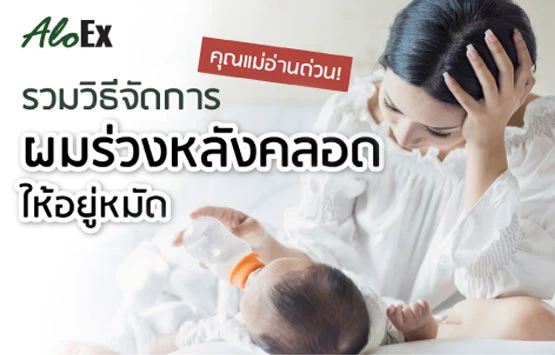
From last time, we discussed hair fall problems that occur during pregnancy — specifically, that pregnancy-related hair fall falls into 2 types: "hair fall during pregnancy" and "hair fall after giving birth." Hair fall during pregnancy occurs because the mother's body is deficient in iron, so there are not enough nutrients to nourish the hair roots. Today we'll learn about hair fall that occurs after giving birth. "Hair fall after giving birth" occurs because after delivering the baby, estrogen hormone levels drop dramatically and suddenly. This condition can be found in nearly every mother, as it is the body's natural mechanism for rebalancing hormones. Estrogen is the female hormone that helps slow the rate of hair shedding. During the period when the mother's body is preparing for pregnancy, the body produces more estrogen. At the same time, the placenta in the womb also produces this hormone — so estrogen levels are much higher than normal, causing hair to shed more slowly and in smaller amounts. But once the mother delivers the baby, hormone levels return to normal — and the hair that had not yet shed due to the effects of estrogen then begins to fall out at last. So in the postpartum period, mothers often find that hair is falling out in abnormally large amounts. This postpartum hair fall typically occurs approximately 2–3 months after delivery, and continues falling out consecutively for 6–12 months — approximately 100–300 strands per day — with the most severe period being around months 3–4 after delivery. This postpartum hair fall is commonly seen because it is a natural bodily mechanism for rebalancing hormones — whereas hair fall during pregnancy is only found in some mothers who have iron deficiency. At this point, many of you may be wondering: so how can AloEx help? AloEx helps reduce postpartum hair fall because it contains galangal (Krachai) extract, which can help balance hormones in the scalp area — so that the rapid rise or fall in hormone levels has less impact on the function of the hair roots, thereby slowing postpartum hair shedding. In addition, AloEx also contains herbal extracts that help stimulate blood circulation — including Mucopolysaccharide compounds from Aloe Vera, Anthocyanin and Triterpenoids from Butterfly Pea Flower, and Asiatic Acid from Gotu Kola — which enable nutrients to nourish the hair roots adequately and thoroughly, so hair roots become stronger and grip hair strands better. Please don't misunderstand — AloEx is not only for pregnant mothers. Because abnormal hormonal changes — whether of female or male hormones — can all cause hair fall and thinning that leads to baldness. So what other factors affect hormonal changes that cause hair fall? Stay tuned for the next post — see you on page @aloex very soon! ^^ Reduce postpartum hair fall with natural products — safe, gentle for mothers and babies — with the 3-Step Set from AloEx. Step 1: Shampoo with AloEx Shampoo, extracted from nature, free from SLS, Silicone, Paraben, Alcohol, and Fragrance. It helps thoroughly detox dirt and chemical residues, opening the way for hair and scalp to receive nourishment in the next step to the fullest. Available in 2 formulas: Original formula for oily hair, rich in over 30 types of herbs that help nourish hair and scalp, reduce hair fall, stimulate new hair growth, reduce itching, dandruff, and control oiliness. Black formula for dry or damaged hair, rich in Black Sticky Rice extract (Oryza Sativa Extract) and Lemon Lavender Oil — adding moisture to bring hair back to being soft, not dry, not frizzy, reducing hair fall, and stimulating more new hair growth than before. Step 2: Treat hair with AloEx Natural Hair Mask — a hair mask with a "silicone-free" formula, also free from SLS, Paraben, and Fragrance. Can be used as a substitute for conditioner. It can nourish from root to tip without worrying about clogging. Rich in Black Sticky Rice extract, Lemon Lavender Oil, and Natural Oils — adding moisture and nourishing to restore dry, damaged, split-end hair back to softness and beauty — looking naturally healthy. Step 3: A leave-on serum — spray whenever you need it throughout the day, at any time. Because it is a clear, liquid serum — not sticky — extracted from nature with no chemical additives. It absorbs and nourishes deeply into the hair roots. For stronger hair and scalp than before — hair that is not brittle, not prone to breakage and fall. Nourish hair and scalp, reduce postpartum hair fall, and build stronger new hair with us. Order now!

Read more »
Why does chemotherapy cause hair loss?

Why does chemotherapy cause hair loss?

Hair on the scalp sheds every day, and the causes of hair fall are numerous — such as genetics, stress, or medical treatments. One of the primary causes of medically induced hair fall is chemotherapy. Cancer treatment with chemotherapy is a widely used method, but this treatment brings with it a side effect — sudden and rapid hair loss. The drugs used in the treatment work by destroying cancer cells, and due to this cell-destroying property, the hair follicle cells are also destroyed, causing hair to fall out very quickly. This type of hair loss caused by chemotherapy is called hair loss during the growth phase, or Anagen Effluvium. Anagen Effluvium occurs approximately 1–2 weeks after chemotherapy begins, and the effects become clearly visible after 1–2 months. It starts with the hair follicle cells dividing abnormally fast, causing hair to grow 0.4 mm per day (compared to the normal rate of 0.33 mm per day), until at a certain point the follicles gradually stop producing hair cells. The hair becomes progressively thinner, growth slows, and the follicles eventually atrophy. However, Anagen Effluvium will gradually resolve and return to normal after treatment is completed — though whether hair regrows normally depends on the condition of the scalp and the number of remaining hair follicles. Additionally, the texture and nature of the hair may change — for example, someone who previously had straight hair may find that the new growth is curly, or the hair color may change. Typically, doctors will prescribe a medication containing Minoxidil 5% for patients to use throughout the treatment period, which can help shorten the duration of hair loss by 50 days. However, patients preparing to undergo chemotherapy can also prepare their scalp health in advance to help mitigate the severity of hair loss or prevent it, by using products that help strengthen hair follicles, keep the scalp moisturized, and absorb the heat toxicity generated by the treatment — before, during, and after receiving treatment. The scalp will thus retain moisture, not become dry and hot, the hair roots will remain strong, and hair will not fall out. If patients are not sure which products to choose for hair restoration, we recommend the shampoo and serum from AloEx, which contain natural herbal extracts that help protect against and absorb the heat toxicity from chemotherapy treatment, while also nourishing the hair roots to remain strong throughout the treatment, stimulating blood circulation so that nutrients can adequately nourish the hair roots, thereby helping to prevent hair fall.

Read more »
Perming and straightening — how it's done

Perming and straightening — how it's done

Human hair can be classified by shape into 2 types: straight hair and curly hair. The reason hair has different shapes comes from one of the key components in hair structure — the disulfide bond. A disulfide bond is a bond formed by the connection of an amino acid called cysteine, which is present in large quantities within the keratin layer that surrounds hair strands. The amount of cysteine that forms disulfide bonds determines whether hair is straight or curly. Hair shape is also related to the shape of the hair follicle — if the follicle is circular, fewer disulfide bonds are formed and the hair strand is straight; if the follicle is oval, more disulfide bonds are formed and the hair is curly. The more disulfide bonds, the curlier the hair. Since disulfide bonds are the primary component determining hair shape, changing the shape of hair — whether straightening (hair relaxing) or changing curly hair to straight, and perming (hair perming) or changing straight hair to curly — relies on the principle of making the disulfide bonds in the hair rearrange. And this is the property of hair straightening and perming solutions! The key chemicals used in hair straightening and perming products — such as hydrogen peroxide, guanidine hydroxide, or ammonium thioglycolate — all have the main function of breaking the existing disulfide bonds in the hair, making the hair pliable so it can be reshaped as desired. For example, using curling rods to arrange the hair into a curly style, or using a flat plate to straighten the hair. After holding the style for a while, the cysteine in the newly styled hair reforms into a new set of disulfide bonds — causing the permed or straightened hair to hold its new shape. However, hair straightening and perming solutions only temporarily change the structure of the disulfide bonds in the hair — they do not provide permanent results. This is because those products have varying durations of effect. In addition, new hair that grows from our follicles will have disulfide bonds in their original form. So if hair is allowed to grow out for a while, the new growth will be straight or curly according to our original hair structure. But repeatedly perming or straightening hair frequently will damage the hair — because it disrupts the hair's pH balance (acid-alkaline balance), causes the outer hair cuticle to open, the core to swell with pores, making hair more susceptible to moisture and sunlight than normal — ultimately leading to dry and split-end hair. To prevent hair from becoming damaged — in addition to avoiding frequent perming or straightening — choose a gentle shampoo, use a conditioning product every time after washing, and choose products that contain sunscreen ingredients to protect hair from UV ray damage. Many thanks for the helpful information from the Department of Pharmaceutical Sciences and Pharmaceutical Industry, Faculty of Pharmacy, Chulalongkorn University, "Cosmetics in Everyday Life," Bangkok: Chulalongkorn University, 2001, p. 164.

Read more »
The hair-loss saga of all mothers

The hair-loss saga of all mothers

Being a teenage girl — dyeing your hair often, styling it a lot — leads to hair fall problems. But did you know that once you become a mother, hair fall problems don't go away either? Let's look at which stages they occur. Hair fall before birth — In reality, hair fall during pregnancy is not a problem that affects every mother. During pregnancy, estrogen levels are typically so high that hair can actually look thicker and darker than before. However, hormonal changes can make hair oily or dry, making it difficult to care for during pregnancy. Some mothers are also more prone to sensitivity during pregnancy, which can cause hair breakage and fall. Another cause of hair fall during pregnancy is iron deficiency in the body, which means there aren't enough nutrients to nourish the hair roots — so hair becomes weak. Hair fall after birth — Postpartum hair fall is something that happens to almost every mother, because estrogen levels drop sharply after giving birth, causing significant hair loss. The hair that falls out is the hair that should have shed during pregnancy but was held in place by the elevated hormones. Once delivery happens, hormone levels drop, and all that hair falls out. It typically falls out heavily for a certain period and then returns to normal. However, even though it is a normal occurrence, the amount of hair that falls out can be alarmingly large. Stress is also another cause of hair fall. The kinds of stress that many mothers encounter are varied — stress about money and the home, stress about children, stress about a husband, and stress about themselves. Sometimes you don't want to be stressed but you just can't help it. When stress builds up, hair starts falling heavily, because stress weakens the body's immune system, disrupts hormones, some hair follicles pause their activity and then fall out, and some people even pull their hair when stressed — causing further hair loss. Hair fall from stress — Hair fall with age — As age increases into middle age and beyond, hormones in the body are produced in smaller amounts, and various organs begin to weaken — hair and scalp included. As we age, scalp pores deteriorate, weaken, become fragile, and decrease in number. Hair is no longer as beautiful and healthy as before — only dryness and coarseness remain, leading to hair fall. Combined with a weaker body overall, and some people having underlying health conditions, this can further affect hair and scalp health. Nourishing the hair roots for strength — As you can see, hair fall problems for mothers can occur at many different stages — and there may be even more than what was listed here. But even as a mother, you don't have to stop being beautiful. You need to take care of and nourish your hair so it stays with you for a long time. Simple nourishment can come from eating nutritious foods, avoiding hair-damaging behaviors, minimizing chemical use on hair and scalp, and choosing natural products — such as AloEx, which helps nourish hair roots to be healthy and strong, naturally extracted, chemical-free, suitable for all genders and ages, and safe even during pregnancy.

Read more »
Warning signs! Entering 'middle age'

Warning signs! Entering 'middle age'

Even if age is just a number, we can't deny that our bodies deteriorate a little every day as we grow older — to the point where sometimes we don't even realize we've started to age. Today, the admin would like to share the warning signs that tell us we've entered middle age. Wrinkles — crow's feet, and things beginning to sag — In youth, skin is firm and elastic, but as we age, it begins to wrinkle — what we call the signs of aging. You can easily spot them on the face: crow's feet, nasolabial folds, under the eyes, at the brow line, on the forehead, and so on. Skin in various parts of the body also begins to sag and lose firmness, becoming loose, soft, and flabby — whether it's wrinkled skin around the neck, sagging under the upper arms, or drooping in the chest area. This happens because the various hormones in the body are produced in smaller amounts. So it's important to start nourishing yourself early. Body losing its former fitness — As we age, a body that was once fit, energetic, and quick-moving changes. Muscles in the body decrease, bones become thinner, strength diminishes, we tire more easily, and we gain weight more easily. Movement becomes slower and more sluggish, and overall vitality isn't what it used to be. In addition, the deterioration of various body systems makes us weaker and more prone to illness — various diseases start to appear. Taking care of your health is therefore extremely important. Mood swings — getting upset even over small things — People who are normally calm, or who were already somewhat irritable, suddenly become more easily irritated — snapping and complaining even over minor matters — and this is a sign of entering middle age. This is found more commonly in women than men, because as we age and estrogen levels decline, the ability to regulate emotions also deteriorates. Men may experience this to a lesser degree, or not at all. If you're going through this, it's recommended to find relaxing activities to do and avoid excessive stress. Hello grays — "Gray hair" is the warning sign that hits hardest emotionally. A strand or two isn't so bad — you can still hide it or pluck it. But more and more keep appearing, turning what was once naturally beautiful dark hair into a head full of gray and white. You don't want to pluck them all for fear of going bald. Many people just let nature take its course. But if you're not okay with gray hair, it's recommended to dye your hair to cover it. Heavy hair fall — scalp beginning to show through — Once-thick, healthy, silky hair gradually starts falling out more heavily as female hormones decline with age. Hair loses moisture, becomes dry and coarse. In men, hair thinning or a receding hairline is commonly found, and some begin to go bald. Hair fall and thinning are truly bothersome problems. Therefore, caring for and nourishing hair and scalp health is very important. If you don't know where to turn, come to AloEx — because it nourishes both hair roots and scalp for strong, healthy hair. Stronger roots mean more growth, less hair fall, safe and chemical-free — even sensitive types can use it.

Read more »
How to revive hair damaged by sun and heat — for summer

How to revive hair damaged by sun and heat — for summer

Just a few months gone by and summer is back again!! TT ... Even though this is the season for showing off skin and bikinis, it's also the season of scalp overheating!!! Some people who don't care or take care of their hair end up with completely damaged hair — totally dry and brittle. Today the admin brings you tips for rescuing heat and sun-damaged hair so we can all get through summer looking gorgeous. 1. Avoid heat — The first thing we should do to reduce scalp overheating is to avoid heat. Because the scalp is already hot — we can't make it hotter, or our hair will be even more damaged than before. This means blow-drying, perming, flat ironing, and washing with warm-to-hot water — avoid them if you can. If you really can't avoid it, reduce how often you do it — from every day down to just a few times a week. 2. Don't shampoo too frequently — The first thing we should do to reduce scalp overheating is to avoid heat. Because the scalp is already hot — we can't make it hotter, or our hair will be even more damaged than before. Whether it's blow-drying, perming, flat ironing, or washing with warm water — avoid it if you can. If you truly cannot avoid it, reduce usage — from every day down to just a few times a week. 3. Avoid chemicals — This summer, hair color has to be bold... but hold that thought. Because with the scalp already overheating, hair is already damaged — adding chemicals will make it even worse. And it's not just chemicals from hair dyeing — it also includes hair styling products such as sprays, mousse, and gels. You don't necessarily have to stop using them altogether, but it's recommended to reduce how much you use. 4. Protect your hair during the day and at night — It's impossible to wear a hat, use an umbrella, or cover your head with a scarf all the time. So the way to protect your hair and scalp from heat damage is to tie your hair up, braid it, or put it in a bun to minimize sun exposure. If you do need to go out in the sun, use an umbrella or wear a hat for extra protection. At night, let your hair down and smooth it out before sleeping. If you're worried about tangling, a loose bun or ponytail is fine. 5. Nourish regularly with products that are good for hair and scalp — The most important thing for hair and scalp care is the shampoo, conditioner, and treatment products you choose. It's recommended to use organic natural extract products, natural oils, or products with minimal chemical content — like AloEx hair care products, which are extracted from over 30 types of natural herbs carefully selected for being good for hair without harming the scalp. It might feel a bit uncomfortable at first, but it's definitely beneficial for your scalp and hair in the long run. For deep nourishment, you should also do hair masks frequently. These are simple how-to tips that ladies can apply to help reduce scalp overheating this summer, so you can enjoy your outings with peace of mind — and beautiful, healthy hair too. ^^

Read more »
Why is hair loss so severe after giving birth?

Why is hair loss so severe after giving birth?

From last time, we discussed hair fall problems that occur during pregnancy — specifically, that pregnancy-related hair fall falls into 2 types: "hair fall during pregnancy" and "hair fall after giving birth." Hair fall during pregnancy occurs because the mother's body is deficient in iron, so there are not enough nutrients to nourish the hair roots. Today we'll learn about hair fall that occurs after giving birth. "Hair fall after giving birth" occurs because after delivering the baby, estrogen hormone levels drop dramatically and suddenly. This condition can be found in nearly every mother, as it is the body's natural mechanism for rebalancing hormones. Estrogen is the female hormone that helps slow the rate of hair shedding. During the period when the mother's body is preparing for pregnancy, the body produces more estrogen. At the same time, the placenta in the womb also produces this hormone — so estrogen levels are much higher than normal, causing hair to shed more slowly and in smaller amounts. But once the mother delivers the baby, hormone levels return to normal — and the hair that had not yet shed due to the effects of estrogen then begins to fall out at last. So in the postpartum period, mothers often find that hair is falling out in abnormally large amounts. This postpartum hair fall typically occurs approximately 2–3 months after delivery, and continues falling out consecutively for 6–12 months — approximately 100–300 strands per day — with the most severe period being around months 3–4 after delivery. This postpartum hair fall is commonly seen because it is a natural bodily mechanism for rebalancing hormones — whereas hair fall during pregnancy is only found in some mothers who have iron deficiency. At this point, many of you may be wondering: so how can AloEx help? AloEx helps reduce postpartum hair fall because it contains galangal (Krachai) extract, which can help balance hormones in the scalp area — so that the rapid rise or fall in hormone levels has less impact on the function of the hair roots, thereby slowing postpartum hair shedding. In addition, AloEx also contains herbal extracts that help stimulate blood circulation — including Mucopolysaccharide compounds from Aloe Vera, Anthocyanin and Triterpenoids from Butterfly Pea Flower, and Asiatic Acid from Gotu Kola — which enable nutrients to nourish the hair roots adequately and thoroughly, so hair roots become stronger and grip hair strands better. Please don't misunderstand — AloEx is not only for pregnant mothers. Because abnormal hormonal changes — whether of female or male hormones — can all cause hair fall and thinning that leads to baldness. So what other factors affect hormonal changes that cause hair fall? Stay tuned for the next post — see you on page @aloex very soon! ^^ Reduce postpartum hair fall with natural products — safe, gentle for mothers and babies — with the 3-Step Set from AloEx. Step 1: Shampoo with AloEx Shampoo, extracted from nature, free from SLS, Silicone, Paraben, Alcohol, and Fragrance. It helps thoroughly detox dirt and chemical residues, opening the way for hair and scalp to receive nourishment in the next step to the fullest. Available in 2 formulas: Original formula for oily hair, rich in over 30 types of herbs that help nourish hair and scalp, reduce hair fall, stimulate new hair growth, reduce itching, dandruff, and control oiliness. Black formula for dry or damaged hair, rich in Black Sticky Rice extract (Oryza Sativa Extract) and Lemon Lavender Oil — adding moisture to bring hair back to being soft, not dry, not frizzy, reducing hair fall, and stimulating more new hair growth than before. Step 2: Treat hair with AloEx Natural Hair Mask — a hair mask with a "silicone-free" formula, also free from SLS, Paraben, and Fragrance. Can be used as a substitute for conditioner. It can nourish from root to tip without worrying about clogging. Rich in Black Sticky Rice extract, Lemon Lavender Oil, and Natural Oils — adding moisture and nourishing to restore dry, damaged, split-end hair back to softness and beauty — looking naturally healthy. Step 3: A leave-on serum — spray whenever you need it throughout the day, at any time. Because it is a clear, liquid serum — not sticky — extracted from nature with no chemical additives. It absorbs and nourishes deeply into the hair roots. For stronger hair and scalp than before — hair that is not brittle, not prone to breakage and fall. Nourish hair and scalp, reduce postpartum hair fall, and build stronger new hair with us. Order now!

Read more »
Why does chemotherapy cause hair loss?

Why does chemotherapy cause hair loss?

Hair on the scalp sheds every day, and the causes of hair fall are numerous — such as genetics, stress, or medical treatments. One of the primary causes of medically induced hair fall is chemotherapy. Cancer treatment with chemotherapy is a widely used method, but this treatment brings with it a side effect — sudden and rapid hair loss. The drugs used in the treatment work by destroying cancer cells, and due to this cell-destroying property, the hair follicle cells are also destroyed, causing hair to fall out very quickly. This type of hair loss caused by chemotherapy is called hair loss during the growth phase, or Anagen Effluvium. Anagen Effluvium occurs approximately 1–2 weeks after chemotherapy begins, and the effects become clearly visible after 1–2 months. It starts with the hair follicle cells dividing abnormally fast, causing hair to grow 0.4 mm per day (compared to the normal rate of 0.33 mm per day), until at a certain point the follicles gradually stop producing hair cells. The hair becomes progressively thinner, growth slows, and the follicles eventually atrophy. However, Anagen Effluvium will gradually resolve and return to normal after treatment is completed — though whether hair regrows normally depends on the condition of the scalp and the number of remaining hair follicles. Additionally, the texture and nature of the hair may change — for example, someone who previously had straight hair may find that the new growth is curly, or the hair color may change. Typically, doctors will prescribe a medication containing Minoxidil 5% for patients to use throughout the treatment period, which can help shorten the duration of hair loss by 50 days. However, patients preparing to undergo chemotherapy can also prepare their scalp health in advance to help mitigate the severity of hair loss or prevent it, by using products that help strengthen hair follicles, keep the scalp moisturized, and absorb the heat toxicity generated by the treatment — before, during, and after receiving treatment. The scalp will thus retain moisture, not become dry and hot, the hair roots will remain strong, and hair will not fall out. If patients are not sure which products to choose for hair restoration, we recommend the shampoo and serum from AloEx, which contain natural herbal extracts that help protect against and absorb the heat toxicity from chemotherapy treatment, while also nourishing the hair roots to remain strong throughout the treatment, stimulating blood circulation so that nutrients can adequately nourish the hair roots, thereby helping to prevent hair fall.

Read more »
Perming and straightening — how it's done

Perming and straightening — how it's done

Human hair can be classified by shape into 2 types: straight hair and curly hair. The reason hair has different shapes comes from one of the key components in hair structure — the disulfide bond. A disulfide bond is a bond formed by the connection of an amino acid called cysteine, which is present in large quantities within the keratin layer that surrounds hair strands. The amount of cysteine that forms disulfide bonds determines whether hair is straight or curly. Hair shape is also related to the shape of the hair follicle — if the follicle is circular, fewer disulfide bonds are formed and the hair strand is straight; if the follicle is oval, more disulfide bonds are formed and the hair is curly. The more disulfide bonds, the curlier the hair. Since disulfide bonds are the primary component determining hair shape, changing the shape of hair — whether straightening (hair relaxing) or changing curly hair to straight, and perming (hair perming) or changing straight hair to curly — relies on the principle of making the disulfide bonds in the hair rearrange. And this is the property of hair straightening and perming solutions! The key chemicals used in hair straightening and perming products — such as hydrogen peroxide, guanidine hydroxide, or ammonium thioglycolate — all have the main function of breaking the existing disulfide bonds in the hair, making the hair pliable so it can be reshaped as desired. For example, using curling rods to arrange the hair into a curly style, or using a flat plate to straighten the hair. After holding the style for a while, the cysteine in the newly styled hair reforms into a new set of disulfide bonds — causing the permed or straightened hair to hold its new shape. However, hair straightening and perming solutions only temporarily change the structure of the disulfide bonds in the hair — they do not provide permanent results. This is because those products have varying durations of effect. In addition, new hair that grows from our follicles will have disulfide bonds in their original form. So if hair is allowed to grow out for a while, the new growth will be straight or curly according to our original hair structure. But repeatedly perming or straightening hair frequently will damage the hair — because it disrupts the hair's pH balance (acid-alkaline balance), causes the outer hair cuticle to open, the core to swell with pores, making hair more susceptible to moisture and sunlight than normal — ultimately leading to dry and split-end hair. To prevent hair from becoming damaged — in addition to avoiding frequent perming or straightening — choose a gentle shampoo, use a conditioning product every time after washing, and choose products that contain sunscreen ingredients to protect hair from UV ray damage. Many thanks for the helpful information from the Department of Pharmaceutical Sciences and Pharmaceutical Industry, Faculty of Pharmacy, Chulalongkorn University, "Cosmetics in Everyday Life," Bangkok: Chulalongkorn University, 2001, p. 164.

Read more »
The hair-loss saga of all mothers

The hair-loss saga of all mothers

Being a teenage girl — dyeing your hair often, styling it a lot — leads to hair fall problems. But did you know that once you become a mother, hair fall problems don't go away either? Let's look at which stages they occur. Hair fall before birth — In reality, hair fall during pregnancy is not a problem that affects every mother. During pregnancy, estrogen levels are typically so high that hair can actually look thicker and darker than before. However, hormonal changes can make hair oily or dry, making it difficult to care for during pregnancy. Some mothers are also more prone to sensitivity during pregnancy, which can cause hair breakage and fall. Another cause of hair fall during pregnancy is iron deficiency in the body, which means there aren't enough nutrients to nourish the hair roots — so hair becomes weak. Hair fall after birth — Postpartum hair fall is something that happens to almost every mother, because estrogen levels drop sharply after giving birth, causing significant hair loss. The hair that falls out is the hair that should have shed during pregnancy but was held in place by the elevated hormones. Once delivery happens, hormone levels drop, and all that hair falls out. It typically falls out heavily for a certain period and then returns to normal. However, even though it is a normal occurrence, the amount of hair that falls out can be alarmingly large. Stress is also another cause of hair fall. The kinds of stress that many mothers encounter are varied — stress about money and the home, stress about children, stress about a husband, and stress about themselves. Sometimes you don't want to be stressed but you just can't help it. When stress builds up, hair starts falling heavily, because stress weakens the body's immune system, disrupts hormones, some hair follicles pause their activity and then fall out, and some people even pull their hair when stressed — causing further hair loss. Hair fall from stress — Hair fall with age — As age increases into middle age and beyond, hormones in the body are produced in smaller amounts, and various organs begin to weaken — hair and scalp included. As we age, scalp pores deteriorate, weaken, become fragile, and decrease in number. Hair is no longer as beautiful and healthy as before — only dryness and coarseness remain, leading to hair fall. Combined with a weaker body overall, and some people having underlying health conditions, this can further affect hair and scalp health. Nourishing the hair roots for strength — As you can see, hair fall problems for mothers can occur at many different stages — and there may be even more than what was listed here. But even as a mother, you don't have to stop being beautiful. You need to take care of and nourish your hair so it stays with you for a long time. Simple nourishment can come from eating nutritious foods, avoiding hair-damaging behaviors, minimizing chemical use on hair and scalp, and choosing natural products — such as AloEx, which helps nourish hair roots to be healthy and strong, naturally extracted, chemical-free, suitable for all genders and ages, and safe even during pregnancy.

Read more »
Warning signs! Entering 'middle age'

Warning signs! Entering 'middle age'

Even if age is just a number, we can't deny that our bodies deteriorate a little every day as we grow older — to the point where sometimes we don't even realize we've started to age. Today, the admin would like to share the warning signs that tell us we've entered middle age. Wrinkles — crow's feet, and things beginning to sag — In youth, skin is firm and elastic, but as we age, it begins to wrinkle — what we call the signs of aging. You can easily spot them on the face: crow's feet, nasolabial folds, under the eyes, at the brow line, on the forehead, and so on. Skin in various parts of the body also begins to sag and lose firmness, becoming loose, soft, and flabby — whether it's wrinkled skin around the neck, sagging under the upper arms, or drooping in the chest area. This happens because the various hormones in the body are produced in smaller amounts. So it's important to start nourishing yourself early. Body losing its former fitness — As we age, a body that was once fit, energetic, and quick-moving changes. Muscles in the body decrease, bones become thinner, strength diminishes, we tire more easily, and we gain weight more easily. Movement becomes slower and more sluggish, and overall vitality isn't what it used to be. In addition, the deterioration of various body systems makes us weaker and more prone to illness — various diseases start to appear. Taking care of your health is therefore extremely important. Mood swings — getting upset even over small things — People who are normally calm, or who were already somewhat irritable, suddenly become more easily irritated — snapping and complaining even over minor matters — and this is a sign of entering middle age. This is found more commonly in women than men, because as we age and estrogen levels decline, the ability to regulate emotions also deteriorates. Men may experience this to a lesser degree, or not at all. If you're going through this, it's recommended to find relaxing activities to do and avoid excessive stress. Hello grays — "Gray hair" is the warning sign that hits hardest emotionally. A strand or two isn't so bad — you can still hide it or pluck it. But more and more keep appearing, turning what was once naturally beautiful dark hair into a head full of gray and white. You don't want to pluck them all for fear of going bald. Many people just let nature take its course. But if you're not okay with gray hair, it's recommended to dye your hair to cover it. Heavy hair fall — scalp beginning to show through — Once-thick, healthy, silky hair gradually starts falling out more heavily as female hormones decline with age. Hair loses moisture, becomes dry and coarse. In men, hair thinning or a receding hairline is commonly found, and some begin to go bald. Hair fall and thinning are truly bothersome problems. Therefore, caring for and nourishing hair and scalp health is very important. If you don't know where to turn, come to AloEx — because it nourishes both hair roots and scalp for strong, healthy hair. Stronger roots mean more growth, less hair fall, safe and chemical-free — even sensitive types can use it.

Read more »
How to revive hair damaged by sun and heat — for summer

How to revive hair damaged by sun and heat — for summer

Just a few months gone by and summer is back again!! TT ... Even though this is the season for showing off skin and bikinis, it's also the season of scalp overheating!!! Some people who don't care or take care of their hair end up with completely damaged hair — totally dry and brittle. Today the admin brings you tips for rescuing heat and sun-damaged hair so we can all get through summer looking gorgeous. 1. Avoid heat — The first thing we should do to reduce scalp overheating is to avoid heat. Because the scalp is already hot — we can't make it hotter, or our hair will be even more damaged than before. This means blow-drying, perming, flat ironing, and washing with warm-to-hot water — avoid them if you can. If you really can't avoid it, reduce how often you do it — from every day down to just a few times a week. 2. Don't shampoo too frequently — The first thing we should do to reduce scalp overheating is to avoid heat. Because the scalp is already hot — we can't make it hotter, or our hair will be even more damaged than before. Whether it's blow-drying, perming, flat ironing, or washing with warm water — avoid it if you can. If you truly cannot avoid it, reduce usage — from every day down to just a few times a week. 3. Avoid chemicals — This summer, hair color has to be bold... but hold that thought. Because with the scalp already overheating, hair is already damaged — adding chemicals will make it even worse. And it's not just chemicals from hair dyeing — it also includes hair styling products such as sprays, mousse, and gels. You don't necessarily have to stop using them altogether, but it's recommended to reduce how much you use. 4. Protect your hair during the day and at night — It's impossible to wear a hat, use an umbrella, or cover your head with a scarf all the time. So the way to protect your hair and scalp from heat damage is to tie your hair up, braid it, or put it in a bun to minimize sun exposure. If you do need to go out in the sun, use an umbrella or wear a hat for extra protection. At night, let your hair down and smooth it out before sleeping. If you're worried about tangling, a loose bun or ponytail is fine. 5. Nourish regularly with products that are good for hair and scalp — The most important thing for hair and scalp care is the shampoo, conditioner, and treatment products you choose. It's recommended to use organic natural extract products, natural oils, or products with minimal chemical content — like AloEx hair care products, which are extracted from over 30 types of natural herbs carefully selected for being good for hair without harming the scalp. It might feel a bit uncomfortable at first, but it's definitely beneficial for your scalp and hair in the long run. For deep nourishment, you should also do hair masks frequently. These are simple how-to tips that ladies can apply to help reduce scalp overheating this summer, so you can enjoy your outings with peace of mind — and beautiful, healthy hair too. ^^

Read more »
10 super natural extracts in AloEx

10 super natural extracts in AloEx

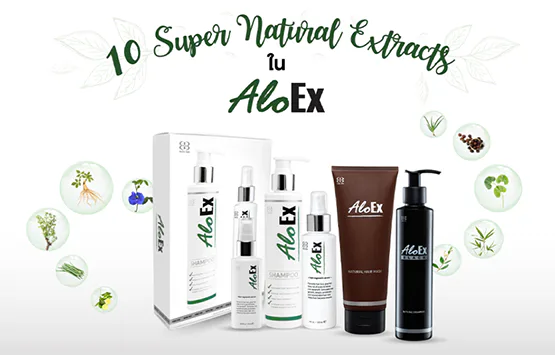
We've long known that AloEx nourishes hair to be strong and helps reduce hair breakage and fall. But do you know which herbs are actually in AloEx? Today the admin is sharing 10 types of natural herbal extracts found in AloEx and the benefits of each. Glory Bower (Clerodendrum) — With such an unusual-sounding name, this herb has truly outstanding properties. Glory Bower (Clerodendrum) is a local Thai herb that helps treat swelling and various allergic reactions of the scalp, as well as treating fungal infections, ringworm, and viruses on the skin. Ginseng — A top beauty and body-nourishing herb. In terms of hair care, Ginseng helps detoxify residues accumulated on the scalp that are clogging the hair follicles, so that blood can circulate more effectively to nourish the hair. This makes hair strong, thick, and dark, reduces breakage and fall, and leaves hair looking shiny from root to tip. It also helps treat pimples and bumps on the scalp. Kaffir Lime — Besides being used as a hair mask to treat head lice, people also use Kaffir Lime to nourish hair. Kaffir Lime helps nourish the scalp and hair to be strong — once both are strong, it stimulates faster new hair growth and reduces hair fall. Kaffir Lime also excellently eliminates dandruff, and when used as a hair mask, it makes hair beautiful and shiny. Gotu Kola — Gotu Kola doesn't just help with bruises or a broken heart! It also helps nourish the scalp and hair. Gotu Kola has properties that stimulate blood circulation in the scalp, helping to nourish the hair roots and make them stronger. Stronger roots mean less hair fall, and new growth is strong, naturally thick, dark, and shiny. It also helps keep the scalp feeling cool and comfortable. With such wonderful properties, you don't have to wait for a heartbreak to use it! Butterfly Pea — Butterfly Pea is a truly remarkable herb, with many well-known properties. It is most famous for helping to nourish hair to be thick, dark, and shiny, and for helping to treat hair fall and thinning. It can also be brewed as a drink for general health benefits. Truly wonderful! Henna — Henna is a beauty herb that has been popular since ancient times for its properties that make hair dark, shiny, smooth, and full-looking. In addition, Henna helps blood circulation nourishing the scalp to function well, stimulates dormant hair follicles back into activity, and helps treat skin inflammation caused by fungus and bacteria. Bamboo Leaf — Bamboo Leaf has properties that strengthen hair and make it thick and dark, help improve blood circulation, and also kill scalp fungus to build the scalp's immunity against sunlight and various chemicals. Aloe Vera — Aloe Vera is well known for its moisturizing and cooling properties. Its most notable benefit is providing moisture to our scalp and hair, keeping the scalp from becoming dry, reducing and eliminating dandruff, and relieving scalp itching. It also helps balance the scalp, allowing new hair to grow more abundantly, and helps hair look shiny and strong with less fall. Soapnut — Soapnut helps reduce dandruff and kills germs on the scalp — both fungi and bacteria that cause hair fall — very effectively. Soapnut also helps hair look shiny. Moringa — In addition to being used in cooking, Moringa has properties that help relieve scalp itching or itching caused by fungus, boost scalp immunity, reduce excess oil that makes the scalp annoyingly greasy, and — most importantly — Moringa helps improve blood circulation to the scalp and can help with hair fall problems.

Read more »
Bye-bye troublesome hair fall — confidence in any situation

Goodbye, annoying hair loss! Feel confident in any situation!

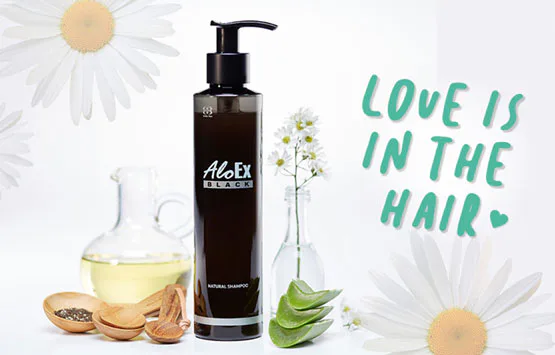
For first-jobber girls like us, we often have to color, perm, and blow-dry our hair, and then it gets so damaged that it falls out and thins. No matter how beautiful your hair once was, if it keeps getting thinner like this, confidence disappears for sure. But wait!! We have a top secret from AloEx — just 2 simple steps to help hair be thick, beautiful, and strong, effectively saying goodbye to hair fall. Whatever style you want to wear, you'll feel more confident — with AloEx Black Shampoo and AloEx Hair Regrowth Serum, two must-have items for the new generation of ladies who care about health and don't like chemicals. Why should ladies love this duo? Because AloEx Black Shampoo and AloEx Hair Regrowth Serum are specifically designed to care for the scalp — gentle and chemical-free — with premium organic herbal extracts such as Black Sticky Rice, Rosemary, Chamomile flower, and Arnica Montana, which go in and detoxify the chemical residues on the scalp — both from hair coloring and from previously used shampoos and conditioners — and also stimulate blood circulation to carry hair vitamins to nourish thoroughly. When hair receives sufficient nourishment, it becomes strong all the way from root to tip, helping hair roots hold on tightly and not fall from the root or break in the middle as before. And what makes the black bottle shampoo extra special is that it contains Black Sticky Rice extract, which can stimulate new hair growth 2 times better than before. Plus it has Lemon Lavender Oil that helps add moisture — leaving hair feeling thick and soft after washing, with strands that fall neatly without tangling, and with more volume too. As for the scent — it's absolutely divine, like aromatherapy. Washing your hair with it is so relaxing. Every time you toss your hair — thick, confident, naturally beautiful!! The special quality of AloEx Black Shampoo lies in its Black Sticky Rice extract, which provides quality protein to the hair roots and also reduces antioxidants that cause scalp weakness, helping to add moisture and increase the density of the hair strands. No more problems for ladies who previously had thin, easily falling hair. Using it regularly helps new hair grow faster. And don't forget to use it together with AloEx Hair Regrowth Serum for even more noticeable results. With a serum that is portable and convenient to use — whether after shampooing or during the day — production technology that extracts herbs into very fine particles allows it to absorb into hair easily and dry quickly, so no worries about stickiness. After use, it gives a cool, comfortable feeling. For those who sit in air-conditioning for long periods or sweat a lot, it can also be used to balance scalp oiliness — and it works! For colored or permed hair, it's safe to use — it won't affect the color or perm wave, and it also nourishes hair at the same time. No more allergic irritation. For ladies with sensitive scalps that are easily irritated, there's nothing more to worry about — because this duo has no fragrance or unnecessary additives, helps reduce the charge found in regular shampoos, and contains no preservatives, silicone, parabens, SLS, or alcohol whatsoever. Extremely gentle and natural — suitable for all genders and ages, safe for both children and pregnant women. An item every household should keep on hand. Excellent quality and great value — AloEx Black Shampoo 200 ml at 680 baht, and AloEx Hair Regrowth Serum 50/120 ml at 590/990 baht. The price may seem a little high, but compared to the quality and concentration of the herbal extracts packed in, it's genuinely worth it — and it lasts a long time too. Available at Watsons, EVEANDBOY, or more conveniently, you can order online at Line ID: AloEx, FB: AloExOfficial. And let's say goodbye to hair fall together!

Read more »
Hero product for thinning hair — with this serum alone, hair fall stops

Must-have item to solve thinning hair problems. Just use hair serum and stop hair loss.

If the face is the heart that ladies must prioritize, then hair is like the body that wraps around that heart. If your face is flawless and skin is glowing but your hair is thin and showing the scalp, it's like having a strong heart but a weak body. So today we're inviting ladies to take care of their hair so it stays with us for a long time. Normally, women's hair falls out no more than 100 strands per day. But in cases where chemicals are accumulating on the scalp from hair care products that have chemical buildup, hair may fall out at more than 100 strands per day — eventually leading to a hair fall and thinning problem that causes a loss of confidence and affects overall appearance. So the simple step to avoid this problem is to reduce, minimize, and stop using shampoos that contain chemicals as their ingredients. Most importantly, if you want new hair to grow strong and stay attached to the scalp for a long time, it is recommended to use AloEx Hair Regrowth Serum! The way to use the serum is very simple — right after shampooing, spray the serum onto the scalp and hair to stimulate blood circulation on the scalp to nourish the hair roots, helping the roots grip the hair strands more firmly. It also helps restore hair follicles to continuously produce hair strands, so new hair grows back faster. And it reduces hair fall and hair breakage as well. Additionally, it contains extracts that help inhibit the DHT hormone, which is the primary cause of hereditary hair fall. You can spray again multiple times throughout the day as needed, because the serum dries quickly, is not sticky, and has no scent. AloEx Serum is made from natural extracts that have been researched by scientists and proven to be good for hair and scalp. The herbal ingredients include: Kaffir Lime, Butterfly Pea, Aloe Vera, Henna, Glory Bower (Clerodendrum), Moringa, Ginseng, Thai Soapnut, Bamboo Leaf, and Gotu Kola. Importantly, it contains no chemicals, no fragrance, and no unnecessary additives. Ladies can therefore use AloEx continuously for a long time with no chemical residue — and hair won't fall out from stopping use either. It also has a lovely herbal scent. It's recommended to shampoo with AloEx Shampoo first, as the shampoo and serum work together in tandem — the shampoo helps cleanse oil and chemical residues that have accumulated and clogged the hair roots, as well as reducing oiliness and scalp itching. The shampoo also conditions the scalp so blood circulation works well, before the serum further helps hair grow faster and become even stronger. Such simple steps — and you can do it all day long like this — are a must-have. With this, beauty isn't limited to just the face anymore. ^^ You can get it at Watsons, EVEANDBOY, BEAUTRIUM, TOPS, or order online conveniently with free shipping — LINE: @AloEx or www.facebook.com/aloexofficial. You can also find more information at www.aloexhair.com

Read more »